HOW WE FARM

By today's standard we are a small farm, operating on our 160 acre home. Here we tend to nearly 70 acres of pasture and 30 acres of cropland in addition to gardens and a small sugar bush in the woods. Being small motivated us to make the most of every acre.
Over time we have settled on an approach to agriculture that has come to be known as "regenerative". At it's heart, regenerative farming goes beyond a "sustainable" farming mindset to focus on actively improving the land and, in turn, the food produced off it. To this end, we work to diversify and perennialize our production all while minimizing soil disturbances (i.e. tillage, chemical use, and grazing). On pasture this is accomplished by employing management-intensive grazing, moving livestock to fresh pasture at least once per day. On croplands we utilize no-till, cover crop, and nutrient management practices. This is all contributes to establishing healthy soils.
Like many farmers, we consider ourselves to be stewards of the land. Perhaps the best measure of how well we're doing this job can be found by assessing the health of our soils. It may be a paradigm shift for some to consider the soil as a living system, but it is ultimately soil biology that drives the ecological processes (e.g. nutrient cycling, water infiltration and storage) that determine the productivity and resilience of farmland soils. As these biological communities receive the opportunity to grow more diverse and abundant they become more efficient at facilitating these processes.
So it's our goal to facilitate the creation and maintenance of a soil biological community capable of yielding nutrient-dense foods, that help improve health and well-being of our communities.
Our Guiding Principles
Farming requires us to be constantly learning and adapting. At the core of what we do, we are grounded in stewardship, pasture-based, and transparency.

Stewardship
We seek to farm in a way that harnesses natural patterns rather than fighting them. We believe that working in harmony with the land results in healthier, more resilient farmland that produces more nutritious foods and ensures the land remains productive for future generations.
Pasture-Based
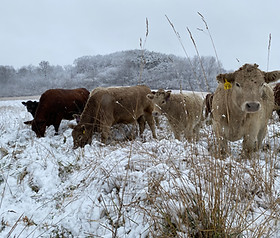
Our farming model is built upon a foundation of diverse perennial pastures. We use livestock to harvest and manage these pastures in a way that produces healthy food as well as numerous ecosystem services that benefit soil, water, and wildlife.

Transparency
We want to bridge the gap between farm and fork and create the opportunity for everyone to understand exactly how their food is produced. We encourage customers to come out, see how we operate, and discuss why we farm the way we do.

BEEF
We raise 100% grass-fed, grass-finished Murray Grey mixed with Red Angus beef cattle. These cattle are moved to fresh pasture every day where they graze on the wide diversity of grasses and forbs in our perennial pastures.
They are our primary pasture managers, responsible for maintaining a productive grassland ecosystem.
LAMB
We raise Katahdin sheep, a breed that we selected for their ability to thrive on pasture. The flock follows our cattle herd in their rotation across pastures.
Cattle act as dead-end hosts to sheep parasites when they precede the flock and tend to favor the taller grasses of the sward.
The sheep don't mind this, as they tend to prefer the lower growing forbs, and are also happy to keep pasture "weeds" in check. This kind of complementary relationship works out great for both cattle and sheep.

EGGS & POULTRY
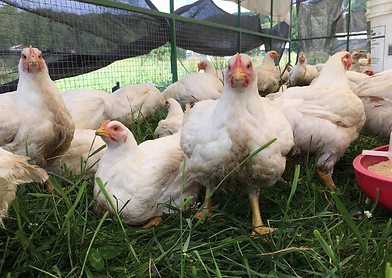
We move our pasture-raised laying hens and broiler chickens, rotating them to fresh pastures on a daily basis where they forage for legumes and insects.
Our laying hens stay on pasture year-round in their mobile coop. For winter they are parked in a spot near water and we get a deep bed-pack straw. The temperature of their mobile coop stays around 40 degrees farenheit, even on the coldest days.
We supplement our birds with feed ground from our own non-GMO grains.


PORK
RAISED WITH GMO-FREE GRAINS
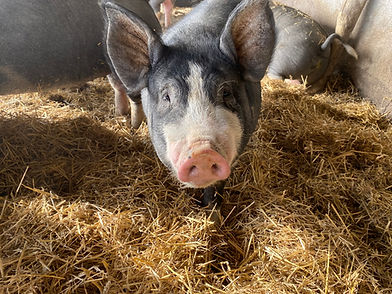
We raise Berkshire Pigs, a heritage breed that produces some of the most flavorful pork. Our pigs are housed in a deep bedded system that receives fresh wheat straw on a weekly basis.
We feed our pigs on feed ground from our own farm's non-GMO grains and give them access to the adjacent pig pasture where they can root and forage for cover crops.

PRODUCE
NO-TILL & NO CHEMICAL GARDENS
We grow our produce in a permanent no-till bed system, constructed using topsoil, compost, and wood chips.
These beds receive on organic inputs and yield some of the best produce you'll find. All vegetables and fruits are available on a seasonal basis.
SWEET STUFF
FROM OUR TREES & BEES TO YOU
Every spring the sap flows from our stand of maples. We collect and evaporate gallons on gallons of it every year. It takes about 40 gallons of maple sap to yield one gallon maples syrup, but it's all worthwhile once you get a taste of it on pancakes or in your coffee.
We started keeping honey bees on the farm in 2006 to not only make honey but also help with polination across the alfalfa fields.
Jams and jellies are made from our blueberry bushes, raspberries, elberberries, and depending on the season strawberries and grapes.


